
A Quarter Review
Equity markets rallied during the third quarter, led by speculative growth stocks and early-cycle value names. Low-quality companies delivered outperformance not seen since the post-COVID market recovery in 2020. A continued risk-on environment created a challenging relative performance period for active managers focused on quality, and the Russell 2500 Index ranked in the top quartile of SMID Cap managers in the quarter.
Within the SMID Cap universe, small caps outperformed mid caps by the third-widest quarterly margin in 30 years—more than 7 percentage points when comparing Russell 2000 Index returns to the Russell Mid Cap Index. Only Q4 2020 and Q3 2008 showed more extreme spreads, and like today, those periods featured dynamic policy shifts and supportive Fed rate-cut cycles.
More than one-fourth of Russell 2500 constituents gained 20% or more during the quarter. In this type of market, attributes typically rewarded by institutional investors—such as low volatility, consistent earnings, and downside protection—acted as relative performance headwinds for quality-oriented strategies.
Performance Summary
The SMID Cap Core Strategy returned 2.96% net of fees in the third quarter, trailing the Russell 2500 Index's 9.00% return. The Strategy's high-quality focus was the primary driver of relative underperformance, extending a headwind that began in April.
Unprofitable companies led the rally, with SMID Cap “non-earners” rising an average of 18%, compared to 7% for companies generating positive net income—the widest gap since 2020. The portfolio's mid-cap overweight also detracted from performance given the unusually strong small-cap outperformance.
Security selection results were adversely affected by the low quality dynamic, with ten of eleven sectors underperforming. Eight holdings declined 15% or more during the quarter, many in the software industry. The portfolio's more conservative positioning led to underperformance in cyclical sectors including Financials and Consumer Discretionary, while underexposure to speculative growth themes in Technology, Health Care, Energy, and Utilities further weighed on results.
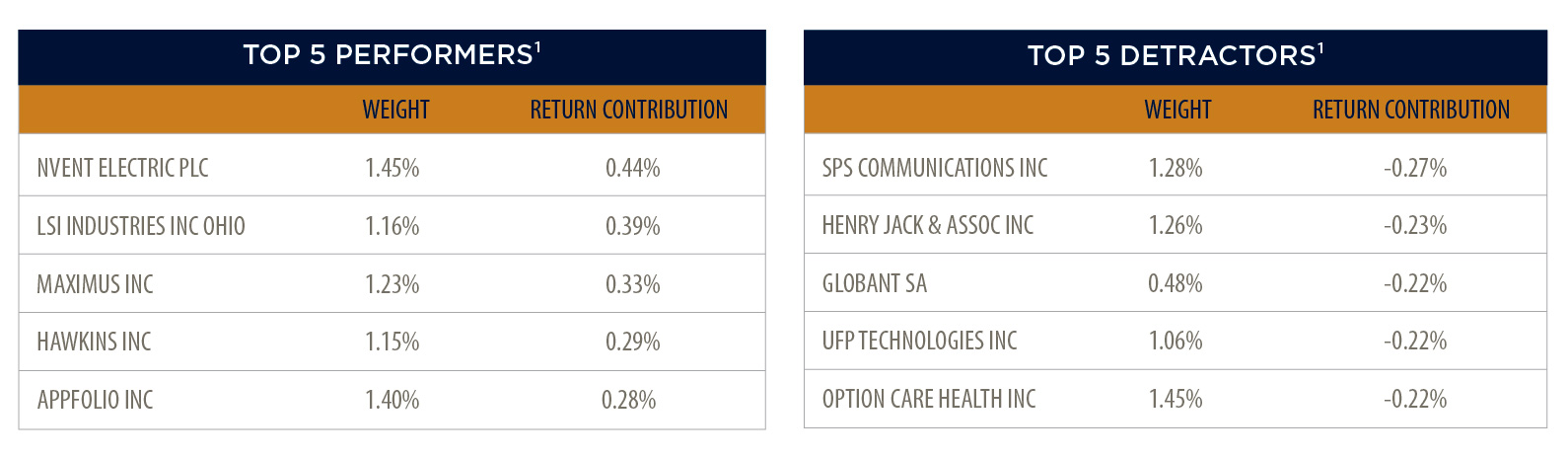
1) Past performance is not indicative of future results, and there is a risk of loss of all or part of your investment. The above does not represent all holdings in the Strategy. Holdings listed might not have been held for the full period. To obtain a copy of Johnson Asset Management’s calculation methodology and a list of all holdings with contribution analysis, please contact your service team. The data provided is supplemental. Please see important disclosures at the end of this document.
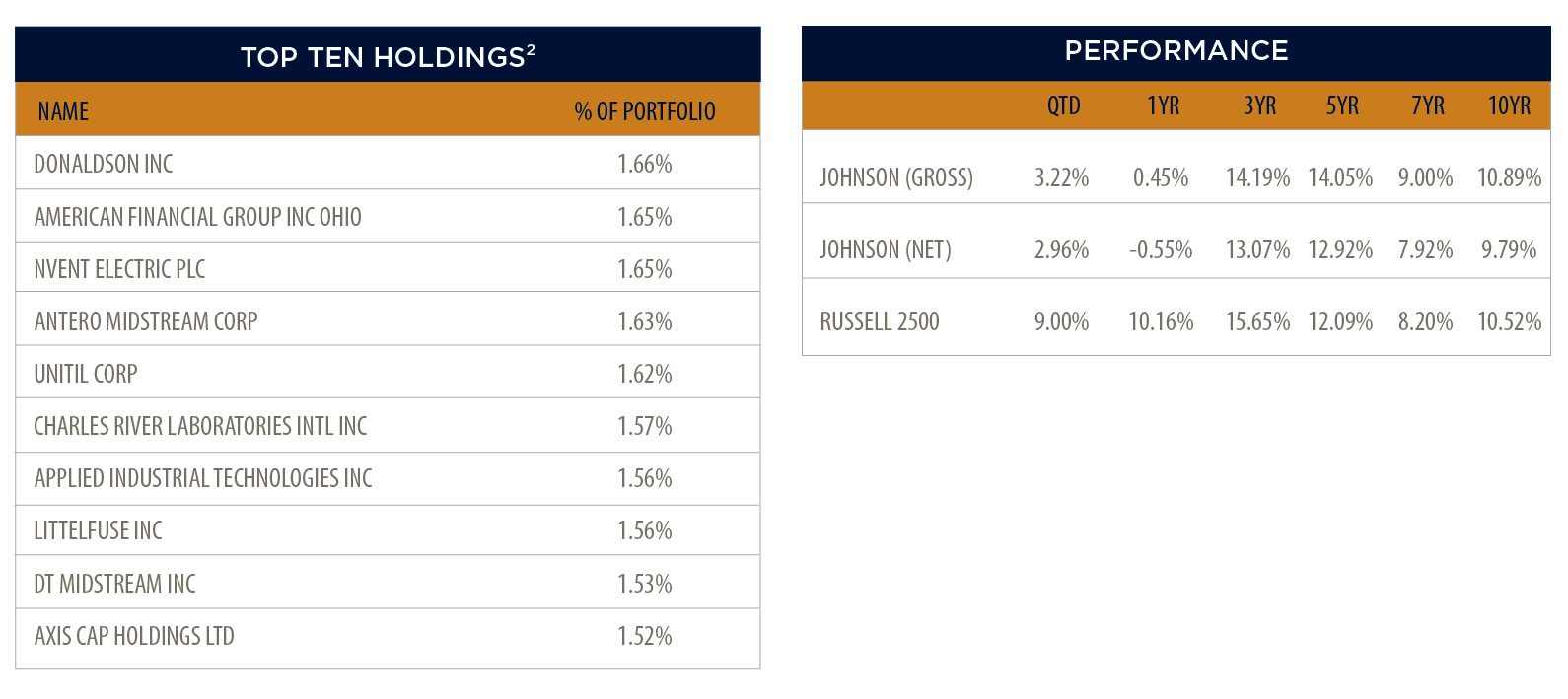
2) Holdings are subject to change. Past performance is not indicative of future results, and there is risk of loss of all or part of your investment. The data provided is supplemental. Please see disclosures at the end of this document.
Market Outlook and Portfolio Positioning
Risk appetite remains elevated as confidence grows that a recession is no longer the base case. Evidence includes robust AI capital expenditures, stabilizing corporate earnings, and accommodative monetary policy. While recent market dynamics have favored high-risk stocks, a continuation of these macroeconomic trends would likely benefit a broader array of equities. This environment should further support SMID Cap performance and narrow the valuation gap relative to large caps, particularly as SMID Cap earnings growth is expected to accelerate. During the quarter, the team trimmed select Industrials positions where valuations had become too expensive. Within Technology, exposure was rebalanced—reducing holdings in companies with fundamental challenges and adding to select small-cap software names exhibiting niche market leadership and attractive long-term growth prospects. Quality investing aligns well with a long-term approach, and risk management remains an important focus, especially after such a sharp move higher in lower quality stocks. Downside protection, reduced volatility, and superior risk-adjusted returns remain core objectives for the Strategy.
The Johnson SMID Cap Core Equity Strategy seeks to consistently outperform the Russell 2500 Index over a full market cycle with less volatility. The Strategy seeks to identify stocks that are making smart allocation decisions, with a favorable combination of quality, valuation, and momentum characteristics. For more information on our products and services, please contact a member of our Sales & Client Service Team at 513.389.2770 or info@johnsonasset.com.
Published 10/21/2025
Johnson Asset Management (JAM) is a division of Johnson Investment Counsel, Inc. (“JIC”), an independent and privately owned Midwestern based investment advisory firm registered with the Securities and Exchange Commission. Johnson Asset Management manages institutional separate account portfolios for a wide variety of for-profit and nonprofit organizations, public agencies, public and private retirement plans, and personal trusts of all sizes. It may also serve as sub-adviser for mutual funds. JIC’s fees are available upon request and may be found in our Form ADV Part 2A. Performance data quoted herein represents past performance. Past performance does not guarantee or indicate future results. All data is current as of September 30, 2025 unless otherwise noted. Returns and net asset value will fluctuate. To determine if this strategy is appropriate for you, carefully consider the investment objectives, risk factors, and expenses before investing. Individual account management and construction will vary depending on each client's investment needs and objectives. Investments employing JIC’s strategies are NOT insured by the FDIC or by any other Federal Government Agency, are NOT Bank deposits, are NOT guaranteed by any Bank or any Bank affiliate, and MAY lose value, including possible loss of principal. Johnson Asset Management claims compliance with the Global Investment Performance Standards (GIPS). GIPS® is a registered trademark of CFA Institute. CFA Institute does not endorse or promote this organization, nor does it warrant the accuracy or quality of the content contained herein. A complete list of firm composites and performance results and the policies for valuing portfolios, calculating performance, and preparing GIPS compliant presentations are available upon request by calling 513-389-2770. Composite: The Johnson SMID Cap Core Equity Composite was created on January 1, 2013, and includes all of JIC’s fee paying, fully discretionary institutional equity portfolios with a minimum of $1,000,000 and an investment objective of small and mid-cap equities. The benchmark for this composite is the Russell 2500, a broadly diversified mid and small cap equity universe of U.S. companies. Eligible new portfolios are included in the composite the first full month after being deemed fully invested. The returns from terminated portfolios are included prior to the date of termination. Effective January 2010, a portfolio will be temporarily removed from this composite if it experiences a net inflow or outflow of cash of 30% or more during a one-month period. Other than the futures contracts that are utilized to replicate the S&P 500, no leverage is used in the Composite portfolios. Portfolios in this composite include cash, cash equivalents, investment securities, interest and dividends. The U.S. dollar is the base currency. All returns reflect the reinvestment of investment income (dividends and/or interest) and capital gains. Valuations and returns are stated in U.S. dollars. Trade date accounting is used. Portfolio returns are calculated using time weighed return methodology on a monthly basis. Net returns shown reflect gross performance less the highest fee schedule for this strategy. The highest investment management fee schedule for this strategy is 1.00%. Actual client returns could also be reduced by brokerage commissions, custodial fees, and other client paid expenses detailed in JIC’s Form ADV Part 2A.