A Quarter Review
The first quarter of 2026 was marked by a shifting macroeconomic landscape and a return of market volatility. Early in the quarter, bond investors saw continued relief from the prior year’s trend of declining inflation and the tailwind of past Federal Reserve rate cuts. However, late in the quarter a sharp escalation of geopolitical tensions in the Middle East – including a temporary disruption in oil exports through the Strait of Hormuz – drove a surge in oil prices of roughly 40% in March, rekindling inflation concerns. In response to the renewed inflationary uncertainty, the Federal Reserve opted to hold its policy rate steady at 3.50%–3.75% during its March meeting, pausing after last year’s easing measures and signaling that only one additional rate cut was likely later in 2026. Nearly all FOMC voters supported this more patient stance.
Interest rates, which had rallied earlier in the quarter on expectations of further Fed easing, reversed course as the Fed struck a more “wait-and-see” approach. By quarter-end, Treasury yields were higher across the curve, led by shorter maturities. The 2-year Treasury yield jumped 32 basis points during the quarter, while 5 year Treasury yields rose 22 basis points. This dynamic resulted in a partial re-flattening of the yield curve after the steepening seen last year. On the credit front, short duration investment-grade corporate bond spreads, which had begun the year at relatively tight levels, were pushed 10 basis points wider by a combination of robust supply and geopolitical turmoil. Meanwhile, U.S. economic data remain mixed: core inflation readings remained on a gradual downtrend despite the oil shock, and the labor market continued to show cracks as payroll growth continued to slow. In all, even with the crosscurrents of elevated yields, mixed economic signals, and a more patient Fed, the short duration bond market was able to post positive returns for the quarter.
Performance Summary
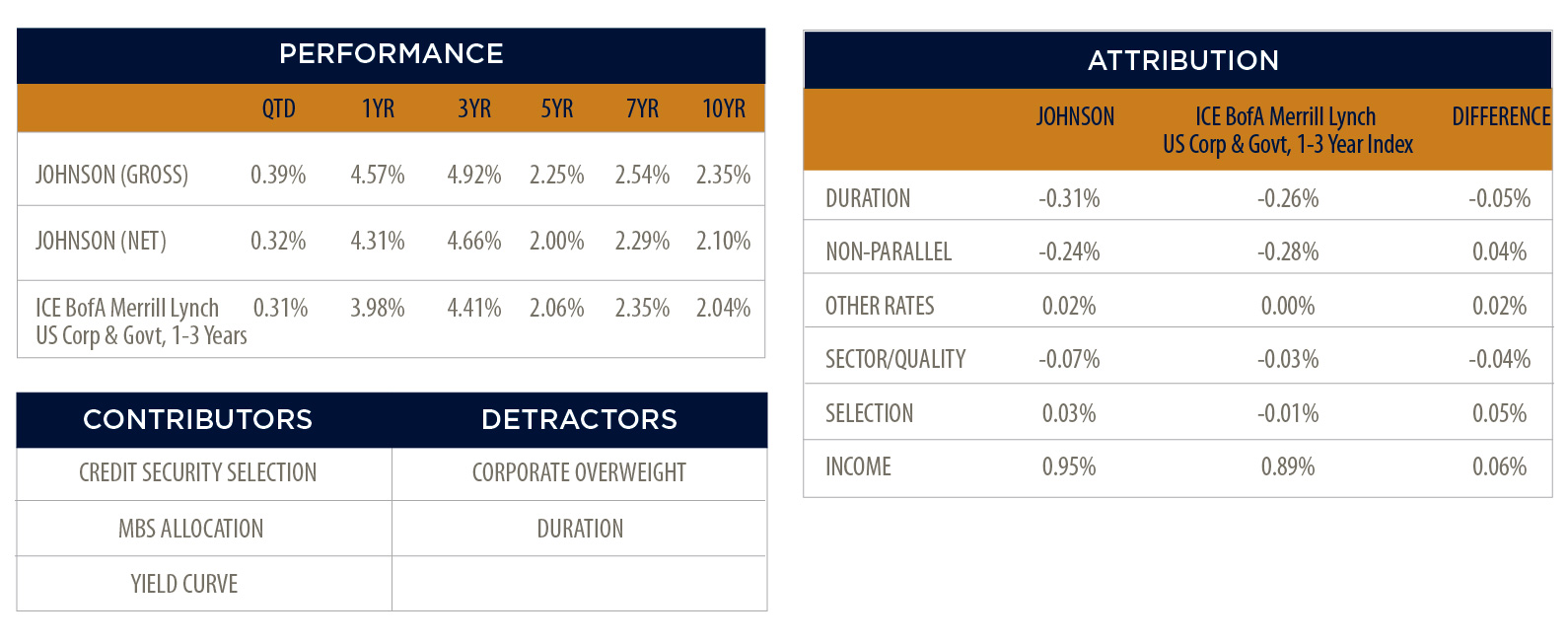
The Johnson Short Duration Fixed Income Strategy returned 0.32% (net of fees) for the first quarter of 2026, slightly outperforming the ICE BofAML US Corporate and Government 1-3 Year Index which returned 0.31%. This slight 1 basis point outperformance was driven by a few different factors. The Strategy’s income advantage, largely driven by its allocation to the corporate bond and MBS sectors, was the primary contributor to outperformance during the quarter. The Strategy’s yield curve positioning was also a slight positive contributor as the yield curve flattened modestly. The Strategy’s duration overweight as well as its overweight allocation to corporate bonds were headwinds as rates rose and spreads widened throughout the quarter. However, this was largely offset by positive security selection, particularly within the corporate sectors. High-quality outperformed low-quality, and our avoidance of AI related software names also helped relative performance.
Market Outlook and Portfolio Positioning
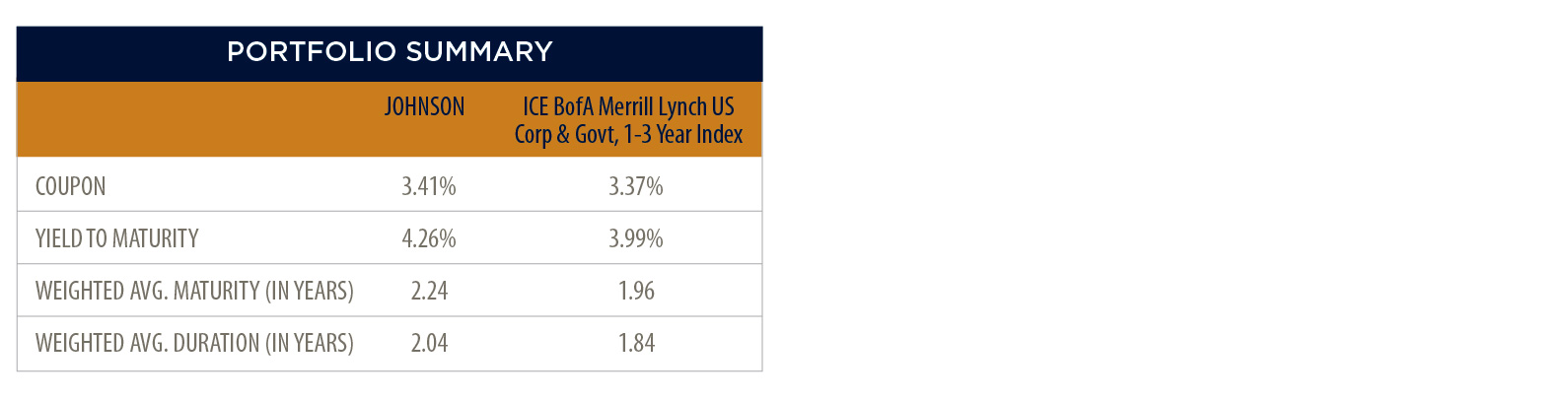
Looking forward, we continue to position portfolios conservatively. Despite the brief, modest widening in credit spreads, they remain below historical averages, particularly in intermediate and long maturities. As a result, the Strategy’s allocation to corporate bonds remains near the lower end of our normal range and concentrated in shorter duration maturities. The recent conflict in Iran has also raised questions about the durability of the U.S. consumer in the face of dramatically higher energy prices. Taken in conjunction with further recent evidence of moderation in the domestic labor market, we believe a more cautious position within credit remains warranted.
While we acknowledge that the spike in oil prices may put temporary upward pressure on headline inflation, higher energy prices have traditionally acted to slow the consumer, thereby pressuring economic growth. As a result, we view the recent back up in rates as an attractive entry point for long-term allocators. The market has now essentially priced out any remaining rate cuts this year, which we view as overly hawkish. Despite recent flattening, we continue to focus the Strategy’s key rate duration away from the long-end of the yield curve in favor of intermediate maturities. As always, we remain committed to delivering a high-quality, consistent approach to building fixed income portfolios. Should you have any questions, please reach out to a member of the Johnson team.
Our primary objective across all duration mandates is to outperform the market with comparable volatility by utilizing our proprietary and unique Quality Yield approach and the deep experience and continuity of our investment team. For more information on our products and services, please contact a member of our Sales & Client Service Team at 513.389.2770 or info@johnsonasset.com.
Published 04/23/2026
Johnson Asset Management (JAM) is a division of Johnson Investment Counsel, Inc. (“JIC”), an independent and privately owned Midwestern based investment advisory firm registered with the Securities and Exchange Commission. Johnson Asset Management manages institutional separate account portfolios for a wide variety of for-profit and nonprofit organizations, public agencies, public and private retirement plans, and personal trusts of all sizes. It may also serve as sub-adviser for mutual funds. JIC’s fees are available upon request and may be found in our Form ADV Part 2A. Performance data quoted herein represents past performance. Past performance does not guarantee or indicate future results. All data is current as of March 31, 2026 unless otherwise noted. Returns and net asset value will fluctuate. To determine if this strategy is appropriate for you, carefully consider the investment objectives, risk factors, and expenses before investing. Individual account management and construction will vary depending on each client's investment needs and objectives. Investments employing JIC’s strategies are NOT insured by the FDIC or by any other Federal Government Agency, are NOT Bank deposits, are NOT guaranteed by any Bank or any Bank affiliate, and MAY lose value, including possible loss of principal. Johnson Asset Management claims compliance with the Global Investment Performance Standards. The Short Duration Fixed Income composite includes all fee paying, fully discretionary, actively managed institutional fixed income portfolios with a minimum value of $500,000 and an investment objective of short duration, investment grade taxable fixed income. The benchmark for this composite is the ICE BofA Merrill Lynch 1-3 Year G/C Index. The ICE BofA Merrill Lynch 1-3 Year Corporate/Government Bond Index includes publicly issued U.S. Treasury debt, U.S. government agency debt, taxable debt issued by U.S. states and territories and their political subdivisions, debt issued by U.S. and non-U.S. corporations, non-U.S. government debt and supranational debt. GIPS® is a registered trademark of CFA Institute. CFA Institute does not endorse or promote this organization, nor does it warrant the accuracy or quality of the content contained herein. JAM’s policies for valuing portfolios, calculating performance and preparing compliant presentations, as well as a complete list of composite descriptions are available upon request. Please contact our office at 513.389.2770 or 3777 West Fork Road, Cincinnati, OH 45247. All returns reflect the reinvestment of investment income (dividends and/or interest) and capital gains. Valuations and returns are stated in U.S. dollars. Trade date accounting is used. Portfolio returns are calculated using time weighed return methodology on a monthly basis. Net returns shown reflect gross performance less the highest fee schedule for this strategy. Actual client returns would also be reduced by brokerage commissions, custodial fees, and other client paid expenses detailed in JIC’s Form ADV Part 2A.