A Quarter Review
Geopolitical headlines dominated markets throughout the second quarter. Early efforts to de-escalate the conflict with Iran proved fragile, contributing to bouts of volatility across asset classes during April and May. By late June, however, prospects for a more durable resolution helped push oil prices back toward levels last seen before the conflict began in late February. While equity investors welcomed the improvement in geopolitical conditions, the bond market's response was more measured.
Interest rates finished the quarter higher across the yield curve as investors weighed the deflationary impact of lower energy prices against solid economic data and a resilient corporate earnings backdrop. Additional uncertainty surrounding the future direction of Federal Reserve policy under Chairman Kevin Warsh also contributed to persistently elevated yields. While the Fed ultimately left policy unchanged, its streamlined post-meeting statement reinforced that inflation and price stability remain key priorities for policymakers. As a result, the bond market continues to price high odds of at least one rate hike during the remainder of the year.
Despite somewhat volatile interest rates, credit markets remained remarkably stable. Investment-grade corporate spreads finished the quarter near historically tight levels, supported by strong economic fundamentals and healthy corporate balance sheets. As a result, investment-grade corporate bonds outperformed duration-matched Treasuries by 117 basis points during the quarter. Performance was relatively consistent across sectors, with industrials, utilities, and financials all generating solid excess returns.
Performance Summary
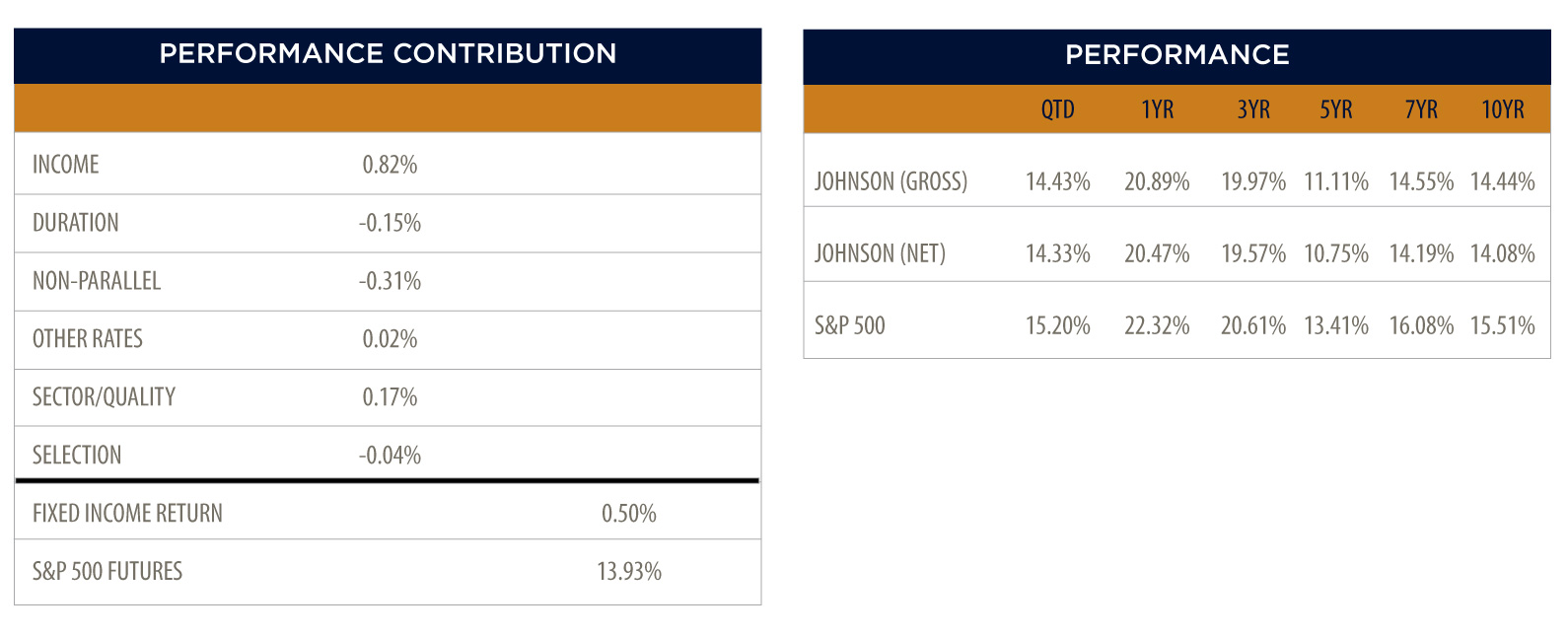
The Johnson Enhanced Index Strategy returned 14.33% net of fees during the second quarter, lagging the S&P 500 Index’s 15.20% return. The primary driver of the Strategy’s underperformance was returns in the bond portion of the portfolio that trailed the embedded cost-of-carry within its equity futures contract positions. Cost-of-carry remains somewhat elevated versus fair value, but has moderated since the Federal Reserve began reducing its Fed Funds rate in 2024 and 2025.
Within the bond portion of the portfolio, rising interest rates muted returns during the quarter and were a headwind to relative performance. The Strategy’s allocation to corporate bonds was additive to performance as corporate spreads tightened, while its allocation to short duration MBS was a detractor as the MBS sector lagged the broader short duration market.
Market Outlook and Portfolio Positioning
We continue to maintain a relatively conservative portfolio posture. While economic and corporate fundamentals remain supportive, credit spreads are near cycle lows and offer limited compensation for taking additional credit risk. As a result, the Strategy's allocation to corporate bonds remains near the lower end of its historical range.
The recent backup in interest rates has created a more attractive opportunity set within fixed income more broadly, and we continue to position portfolios with a modest duration overweight. Although energy prices have retreated from their recent highs, the bond market continues to price at least one additional rate increase over the remainder of the year. We believe the deflationary impulse from lower oil and gas prices, coupled with moderating inflation pressures, should ultimately provide the Federal Reserve with justification to leave policy rates unchanged for the foreseeable future. In the absence of additional monetary tightening, we would expect the yield curve to remain somewhat steeper than current levels, which should benefit the Strategy's underweight position at the long end of the curve.
As always, we remain disciplined in our approach to constructing high-quality fixed income portfolios designed to deliver consistent long-term results. Should you have any questions, please reach out to a member of the Johnson team.
Our primary objective is to outperform the S&P 500 Index with low tracking error and comparable volatility by replicating the Large Cap Equity market using Index Futures, combined with short duration investment grade Fixed Income securities. For more information on our products and services, please contact a member of our Sales & Client Service Team at 513.389.2770 or info@johnsonasset.com.
Published 07/27/2026
Johnson Asset Management (JAM) is a division of Johnson Investment Counsel, Inc. (“JIC”), an independent and privately owned Midwestern based investment advisory ?rm registered with the Securities and Exchange Commission. Johnson Asset Management manages institutional separate account portfolios for a wide variety of for-pro?t and nonpro?t organizations, public agencies, public and private retirement plans, and personal trusts of all sizes. It may also serve as sub-adviser for mutual funds. JIC’s fees are available upon request and may be found in our Form ADV Part 2A. Performance data quoted herein represents past performance. Past performance does not guarantee or indicate future results. All data is current as of June 30, 2026 unless otherwise noted. Returns and net asset value will ?uctuate. To determine if this strategy is appropriate for you, carefully consider the investment objectives, risk factors, and expenses before investing. Individual account management and construction will vary depending on each client's investment needs and objectives. Investments employing JIC’s strategies are NOT insured by the FDIC or by any other Federal Government Agency, are NOT Bank deposits, are NOT guaranteed by any Bank or any Bank af?liate, and MAY lose value, including possible loss of principal. Johnson Asset Management claims compliance with the Global Investment Performance Standards (GIPS). A complete list of ?rm composites and performance results and the policies for valuing investments, calculating performance, and preparing GIPS Reports are available upon request by calling 513-389-2770. GIPS® is a registered trademark of CFA Institute. CFA Institute does not endorse or promote this organization, nor does it warrant the accuracy or quality of the content contained herein. The Enhanced Index composite was created on January 1, 2005 with a composite inception of 7/31/2004, and includes all fee paying, fully discretionary equity portfolios with a minimum of $1,000,000 and an investment objective of replicating the S&P 500 Index, utilizing equity futures contracts and short duration fixed income securities. The benchmark for this composite is the S&P 500 Index, a broadly diversified largecap equity universe of U.S. companies. Eligible new portfolios are included in the composite the ?rst full month after being deemed fully invested. The returns from terminated portfolios are included prior to the date of termination. Effective January 2010, a portfolio will be temporarily removed from this composite if it experiences a net in?ow or out?ow of cash of 30% or more during a one-month period. Other than the futures contracts that are utilized to replicate the S&P 500, no leverage is used in the Composite portfolios. Portfolios in this composite include cash, cash equivalents, investment securities, interest and dividends. The U.S. dollar is the base currency. All returns re?ect the reinvestment of investment income (dividends and/or interest) and capital gains. Valuations and returns are stated in U.S. dollars. Trade date accounting is used. Portfolio returns are calculated using time weighed return methodology on a monthly basis. Net returns shown re?ect gross performance less the highest fee schedule for this strategy. The investment management fee schedule for this strategy is as follows: 0.25% on the first $50 million, 0.20% on the next $50 million, 0.10% on the next $400 million, and 0.05% thereafter. The highest investment management fee schedule for this strategy is 0.25%. Actual client returns could also be reduced by brokerage commissions, custodial fees, and other client paid expenses detailed in JIC’s Form ADV Part 2A.