
A Quarter Review
Is anyone surprised that the first quarter was dominated by policy headlines? While markets were convinced President Trump would run his 2016 playbook, the first quarter was a stark reminder that this is a whole new ballgame. Instead of focusing on kickstarting growth through deregulation and easier fiscal policy, the White House has instead directed its attention to trade policy as an early priority. While the details seemed to change by the day, if not hour, the market was convinced that the overall framework could jeopardize the outlook for economic growth and corporate earnings. As a result, bond yields fell across the yield curve, and the bond market once again priced in hope for the Fed to resume its rate cut campaign. Corporate bond spreads took their cues from equity market jitters and widened 14 basis points during the quarter.
Performance Summary
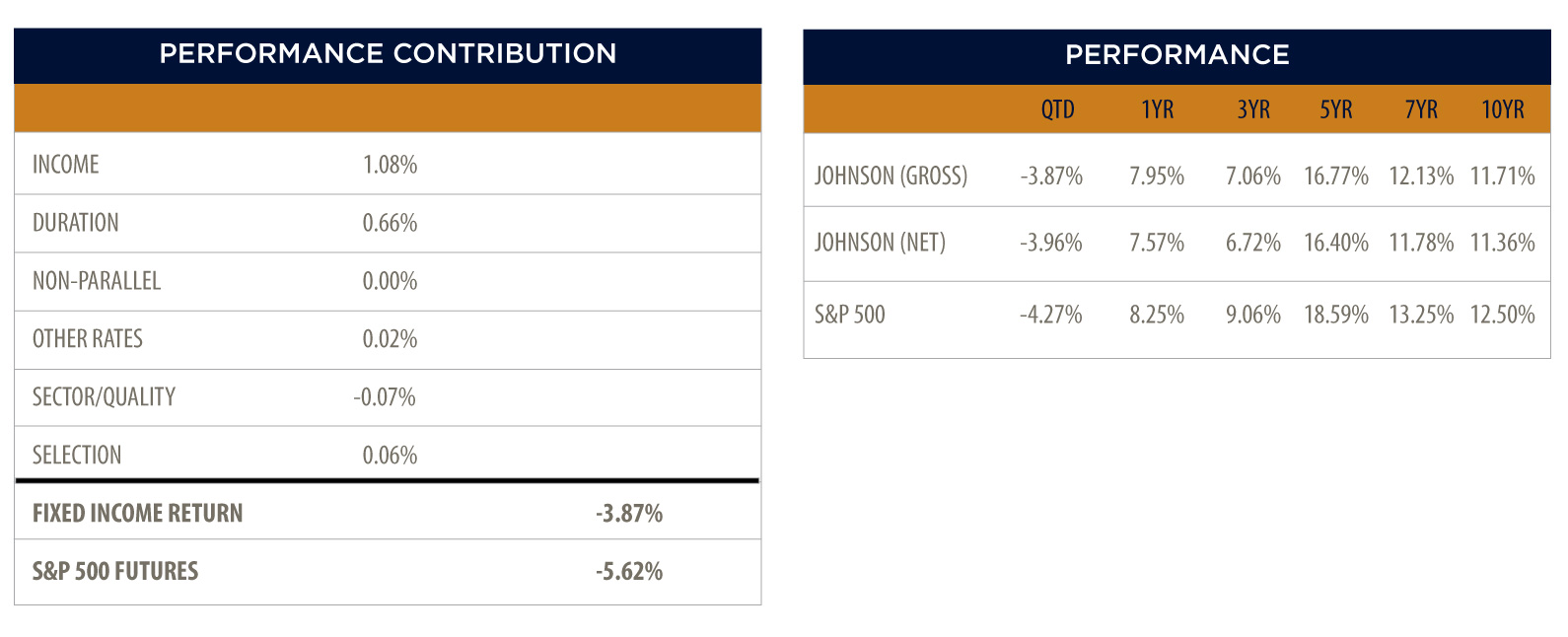
The Johnson Enhanced Index Strategy fell -3.96% net of fees during the first quarter, outperforming the S&P500 Index which closed the quarter down -4.27%. The primary driver of the Strategy’s relative outperformance was returns in the bond portion of the portfolio that exceeded the embedded cost-of-carry within its equity futures contract positions. Cost-of-carry remains somewhat elevated but declined throughout the quarter as equity investor sentiment deteriorated.
Within the bond portfolio, interest rates fell across the front end of the yield curve, which contributed positively to performance. The Strategy’s focus on higher-yielding investment grade corporate bonds was additive to performance but was slightly offset by widening short duration bond spreads. The Strategy’s allocation to mortgage-backed securities was also a modest boost to performance as mortgage-backed security spreads tightened during the quarter.
Market Outlook and Portfolio Positioning
Looking forward, we believe that policy induced volatility is likely to persist. While we remain defensive in our overall credit allocation, we view spread widening as an opportunity to add incremental credit weight at more attractive valuations. Throughout the first quarter, the Enhanced Index Strategy gradually shifted its credit contribution to duration upwards to take advantage of improving valuations in credit. Interest rates ended the quarter toward the lower end of the recent range. While we still prefer to maintain some duration in government securities as a hedge to risk asset volatility, we have modestly reduced the Strategy’s overall rate sensitivity as interest rates have fallen. Should interest rates retrace their recent move downward, we may look to add duration to further balance credit spread volatility. Overall, the Strategy remains well positioned to withstand market volatility, and we are prepared to take advantage of valuation opportunities in credit should they arise.
Our primary objective is to outperform the S&P 500 Index with low tracking error and comparable volatility by replicating the Large Cap Equity market using Index Futures, combined with short duration investment grade Fixed Income securities. For more information on our products and services, please contact a member of our Sales & Client Service Team at 513.389.2770 or info@johnsonasset.com.
Published 04/21/2025
Johnson Asset Management (JAM) is a division of Johnson Investment Counsel, Inc. (“JIC”), an independent and privately owned Midwestern based investment advisory firm registered with the Securities and Exchange Commission. Johnson Asset Management manages institutional separate account portfolios for a wide variety of for-profit and nonprofit organizations, public agencies, public and private retirement plans, and personal trusts of all sizes. It may also serve as sub-adviser for mutual funds. JIC’s fees are available upon request and may be found in our Form ADV Part 2A. Performance data quoted herein represents past performance. Past performance does not guarantee or indicate future results. All data is current as of March 31, 2025 unless otherwise noted. Returns and net asset value will fluctuate. To determine if this strategy is appropriate for you, carefully consider the investment objectives, risk factors, and expenses before investing. Individual account management and construction will vary depending on each client's investment needs and objectives. Investments employing JIC’s strategies are NOT insured by the FDIC or by any other Federal Government Agency, are NOT Bank deposits, are NOT guaranteed by any Bank or any Bank affiliate, and MAY lose value, including possible loss of principal. Johnson Asset Management claims compliance with the Global Investment Performance Standards (GIPS). A complete list of firm composites and performance results and the policies for valuing portfolios, calculating performance, and preparing GIPS compliant presentations are available upon request by calling 513-389-2770. GIPS® is a registered trademark of CFA Institute. CFA Institute does not endorse or promote this organization, nor does it warrant the accuracy or quality of the content contained herein. Composite: The Johnson SMID Cap Core Equity Composite was created on January 1, 2013, and includes all of JIC’s fee paying, fully discretionary institutional equity portfolios with a minimum of $1,000,000 and an investment objective of small and mid-cap equities. The benchmark for this composite is the Russell 2500, a broadly diversified mid and small cap equity universe of U.S. companies. Eligible new portfolios are included in the composite the first full month after being deemed fully invested. The returns from terminated portfolios are included prior to the date of termination. Effective January 2010, a portfolio will be temporarily removed from this composite if it experiences a net inflow or outflow of cash of 30% or more during a one-month period. Other than the futures contracts that are utilized to replicate the S&P 500, no leverage is used in the Composite portfolios. Portfolios in this composite include cash, cash equivalents, investment securities, interest and dividends. The U.S. dollar is the base currency. All returns reflect the reinvestment of investment income (dividends and/or interest) and capital gains. Valuations and returns are stated in U.S. dollars. Trade date accounting is used. Portfolio returns are calculated using time weighed return methodology on a monthly basis. Net returns shown reflect gross performance less the highest fee schedule for this strategy. The highest investment management fee schedule for this strategy is 1.00%. Actual client returns could also be reduced by brokerage commissions, custodial fees, and other client paid expenses detailed in JIC’s Form ADV Part 2A.