
Navigating AI Disruption in Software
In recent months, software has sold off sharply as the industry faces AI disruption fears. Amid the uncertainty, the market has not waited for the long-term winners and losers to be sorted out – the broad group has seen heavy indiscriminate selling. The iShares Expanded Tech-Software ETF (IGV) has fallen nearly 30% from its September peak, as the market prices in substantial structural risk. AI platforms from OpenAI and Anthropic’s Claude are demonstrating the ability to automate complex workflows, generate code, and navigate software interfaces with increasing autonomy in a way that was difficult to foresee a few short years ago. The level of disruption being priced into the software space has sparked debate among investors – is this a buying opportunity or a true paradigm shift? When the market prices in disruption of this magnitude, the event warrants serious discussion.
Disruption is a Constant in Technology
The history of Technology is defined by disruption. It is often more abrupt than incumbents anticipate and more permanent than early skeptics expect. The internet severely damaged newspaper economics. Ecommerce disrupted brick and mortar retail. Streaming dismantled the cable television bundle that was once dominant. Smartphones rendered feature phones obsolete within a handful of years. The pattern is consistent: companies that appear cheap at the onset of a structural shift frequently turn out to be value traps rather than bargains. The multiple a business once commanded can become irrelevant quickly when its core market is being fundamentally challenged.
One prime example of this is BlackBerry. Before the iPhone’s introduction in 2007, BlackBerry was a dominant enterprise smartphone company, trading at 40x+ forward earnings at its peak. BlackBerry owned the corporate inbox on mobile. It offered secure email, enterprise-grade IT controls, and a physical keyboard that commanded fierce loyalty. The competitive moat appeared deep and durable.
The competitive impact of the iPhone took a couple of years to fully materialize, but once it did, BlackBerry’s valuation never recovered. The chart below illustrates the progression: the multiple contracted from roughly 30x to below 5x as growth decelerated and the market priced in permanent impairment. Android compounded the pressure, and customer defection accelerated. The stock appeared cheap at 15x forward earnings, and again at 10x, but it continued lower each time. BlackBerry was cheap because the market foresaw potential disruption. That thesis played out and the stock never recovered.
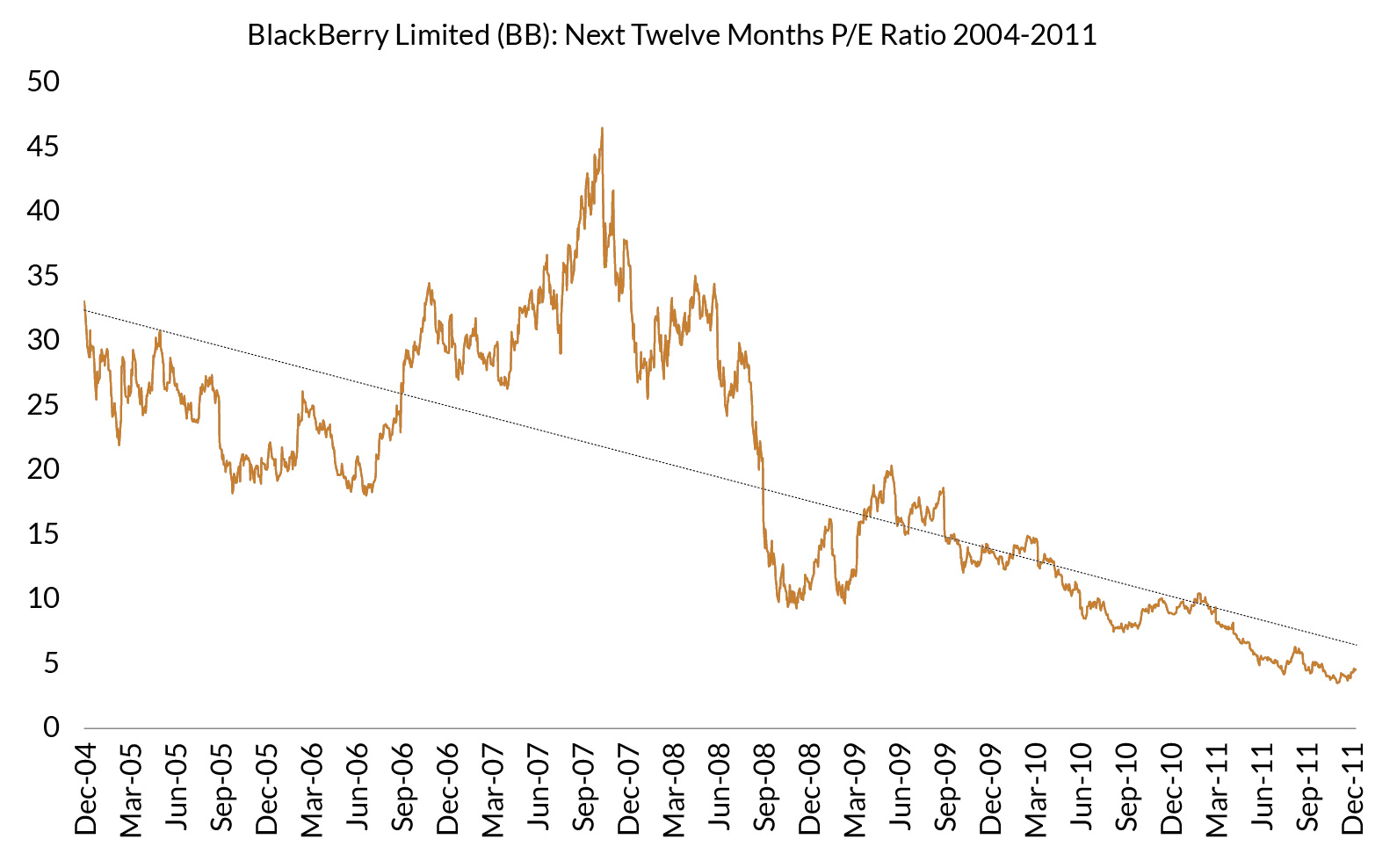
Source: Johnson Asset Management, FactSet, data from 2004-2011
Key Risks for Software Incumbents Today
We are entering the age of agentic AI, where AI agents are capable of autonomously planning and executing complex, multi-step tasks with minimal human involvement. Agents interact with software the way a human would: clicking, typing, making decisions, and operating across software tools. The implication for enterprise software is direct. While incumbents are adopting, the industry still broadly prices on a per-seat basis, tying revenue to the number of humans using the product. As agents absorb more of that work, the foundation of that pricing model comes under pressure.
Beyond the pricing model question lies a more fundamental strategic uncertainty: who will capture the value that agentic AI creates? Incumbent software vendors are positioned to embed agents into their existing platforms, leveraging proprietary data and deep customer integrations to maintain relevance. That is a credible path. However, AI labs are simultaneously building agent layers that sit above software incumbents and work across different tools (not just in one application). These systems interact directly with customer data and workflows, potentially pushing the incumbent software’s AI agent out or making it less relevant. Nothing is set in stone today, and that’s part of the problem for software valuations. Uncertainty is a major hurdle for an industry where once sticky recurring revenue is in question and much of the valuation argument comes from terminal value.
Not All Software Carries Equal Risk
We believe that disruption risk is not uniform across the software landscape, and that matters for how we think about positioning.
Security software is arguably the most insulated from near-term disruption, although that’s not stopped it from drawing down on fears of Claude’s expanding capabilities. AI does not reduce enterprise security requirements. Rather, it raises the sophistication of threats and expands the complexity of environments that need to be protected, which is potentially additive to demand. Platforms in this category likely carry structural tailwinds that set them apart in the broader software debate.
Infrastructure software is arguably in a favorable position. Rather than perform business functions like HR or CRM, this software performs tasks like running, storing, connecting, and monitoring computer systems. Instead of displacing demand for infrastructure, the growth of AI workloads often amplifies it. More models in production generally lead to more compute, more data movement, and more tooling required to manage increasingly complex environments. While we don’t view infrastructure as highly as security, we do view it as an area that looks more resilient to AI risk.
Application software with Systems of Record (SoR) faces more moderate but potentially manageable risk. A System of Record is the authoritative source of truth for a critical set of business data. Prominent examples include the CRM that owns customer relationships, the HR platform that houses employee records, or the ERP that governs financial and operational data. These systems are deeply embedded in enterprise operations, and AI agents remain dependent on them as the underlying data layer. While workflows evolve, the incumbent remains involved in a key role. The transition is unlikely to be painless, but companies with deep systems of record have a credible basis for adaptation. Disruption risk remains, but we can see long-term winners emerging from this category.
Application software without SoRs carries the highest risk. These products facilitate workflows, such as project management, but do not own the underlying data. This makes them more exposed to displacement, whether by AI agents performing equivalent functions, or by hyperscalers bundling similar capability into broader platforms. This group has underperformed most sharply in the selloff, and in our assessment the market’s skepticism is reasonably grounded. We believe a software rally could spark a near-term recovery, but long-term fundamental health needs to be proven and arguably is more at risk.
Our View: Be Patient and Selective
The risks AI poses to software incumbents are real, and they should not be hastily dismissed. At the same time, valuations across the software space have compressed. We believe there is an opportunity for long-term, selective investors as the disruption narrative evolves and the fog of uncertainty lifts.
That said, we do not believe now is the time to be overly aggressive with software positioning. We see momentum as an important risk management tool that matters in this market. A stock with an attractive valuation but deteriorating price momentum is frequently a signal that the market’s fundamental reassessment has not yet run its course.
Historically, inexpensive stocks with poor momentum often continue underperforming before they recover – valuation alone is not sufficient when the market is actively repricing business risk. In a dynamic period like this, investment decisions are best made by taking a fresh assessment of quality, reexamining valuation assumptions, and giving greater consideration to momentum. Employing that discipline will help identify the best risk-adjusted, long-term investment opportunities in an industry where there are plenty of stocks “on sale” today.
Published 03/16/2026
Any expectations presented should not be taken as a guarantee or other assurance as to future results. Our opinions are a reflection of our best judgment at the time this presentation was created, and we disclaim any obligation to update or alter forward-looking statements as a result of new information, future events or otherwise. The material contained herein is based upon proprietary information and is provided purely for reference and as such is confidential and intended solely for those to whom it was provided by Johnson Asset Management. If you have any questions about our equity strategies and how we might tailor them to fit your investment objectives, please call 513.389.2770 or via email at info@johnsonasset.com.