
From Rates to Ratios: Exploring the Effect of Interest Rates on Equity Valuations
Equity investors are faced with a wide range of factors when it comes to evaluating investment opportunities. Whether it’s company fundamentals, macroeconomic factors, or portfolio risk management, there’s a myriad of considerations that can inform our decisions. Among those considerations, interest rates have been a particularly important economic function of late. Due to the dramatic change in monetary policy over the last several years, there’s been an abrupt increase in the level of interest rates.
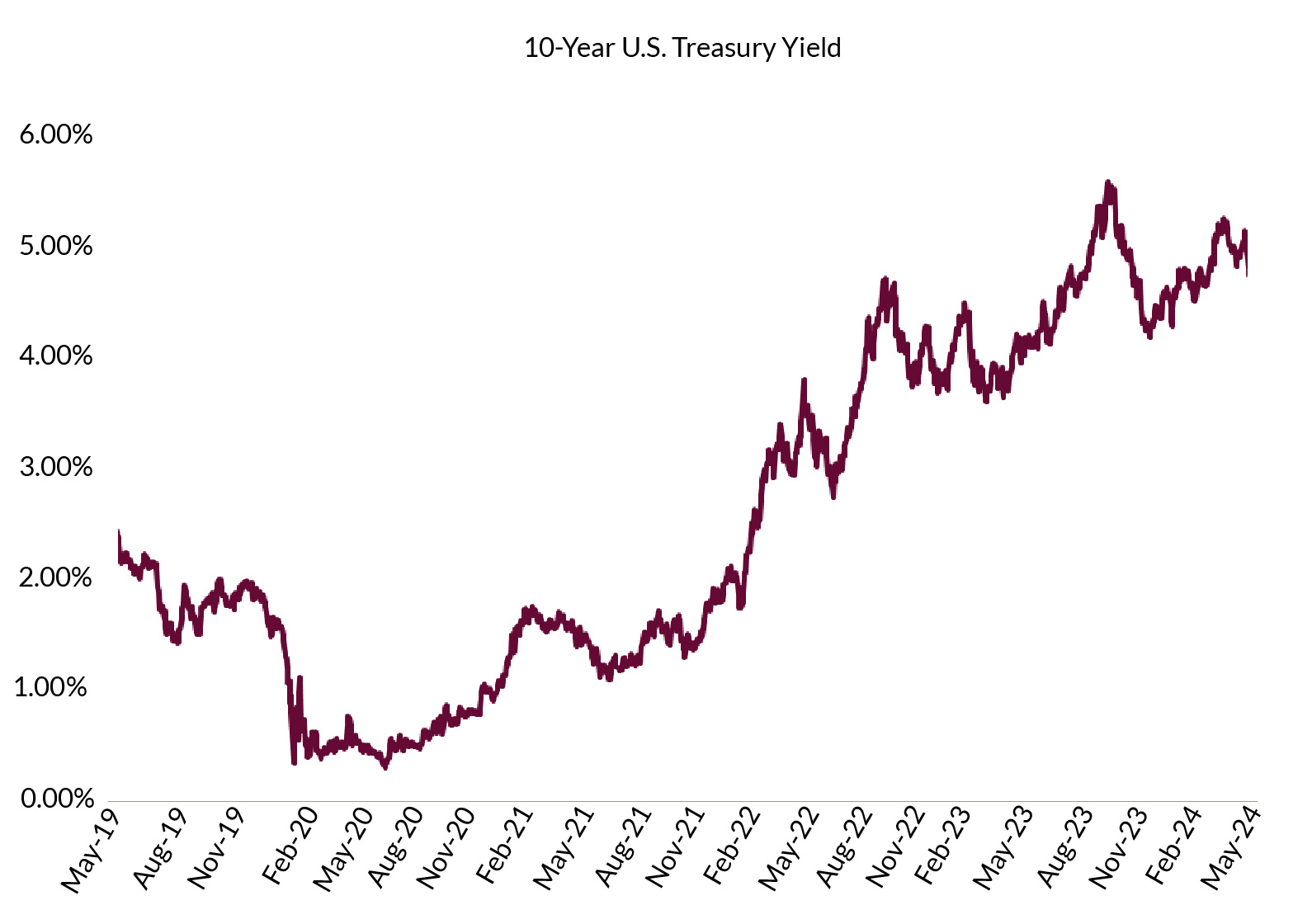
Source: Johnson Asset Management, Bloomberg, data as of 5/31/2024
The cost of borrowing money plays a crucial role in financial markets and influences equity valuations. In theory, analysts derive a company’s value, and therefore its stock price, from the expectations about its future cash flows and the perceived risk of those cash flows. Dusting off our old undergraduate finance textbooks, we are reminded that the Capital Asset Pricing Model (CAPM) provides a basic framework for developing a discount rate, or cost of equity, to apply to those future cash flows.
Inputs into the CAPM include the stock’s beta, the equity risk premium, and the risk-free rate, which is commonly perceived to be the rate on U.S. treasuries. The CAPM indicates that holding all else constant, the cost of equity will rise as the risk-free rate rises and investors demand higher returns for the additional risk of equity investment.
Assuming the use of a discounted cash flow model with a discount rate derived from the CAPM, we can analyze the impact of interest rates on equity valuations through the Price-to-Earnings (P/E) ratio, also referred to as a P/E “multiple.” To do so, we first dissect stock market performance into the contribution of earnings growth and the impact of a change to the P/E ratio. As seen below, since 2019, there have been significant swings in the overall market P/E ratio, explaining a larger year-to-year contribution to the market’s price change than the changes in earnings estimates.
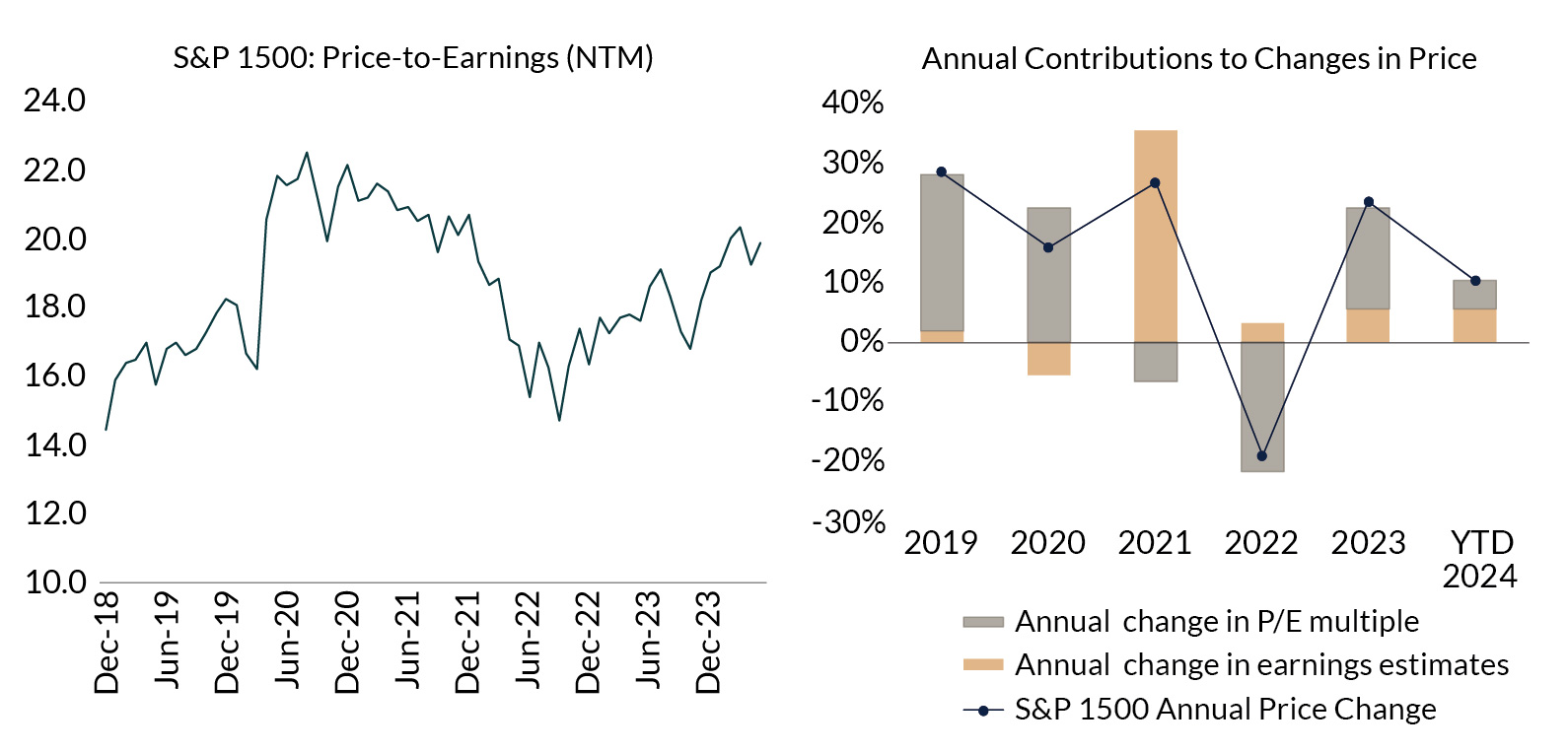
Source: Johnson Asset Management, FactSet, data as of 5/31/2024
What causes the market’s P/E multiple to change so dramatically from year to year? We have taken our analysis a step further to help answer this question. Relying again on the discounted cash flow model for valuation with the CAPM-derived discount rate, we can estimate the impact of the changes in the risk-free rate on the overall change in the P/E ratio. Isolating the impact of interest rates leaves behind the change in the P/E multiple from other sources, such as expectations for future earnings growth, expected duration of cash flows, and the equity risk premium. For example, our analysis shows that interest rates accounted for nearly all of the ~20% decline in the stock market’s P/E multiple in 2022. Meanwhile, thus far in 2024, the market is pricing in some combination of stronger expected future growth, longer expected duration of cash flows, or less risk, as the P/E ratio has risen despite the headwind of rising interest rates.
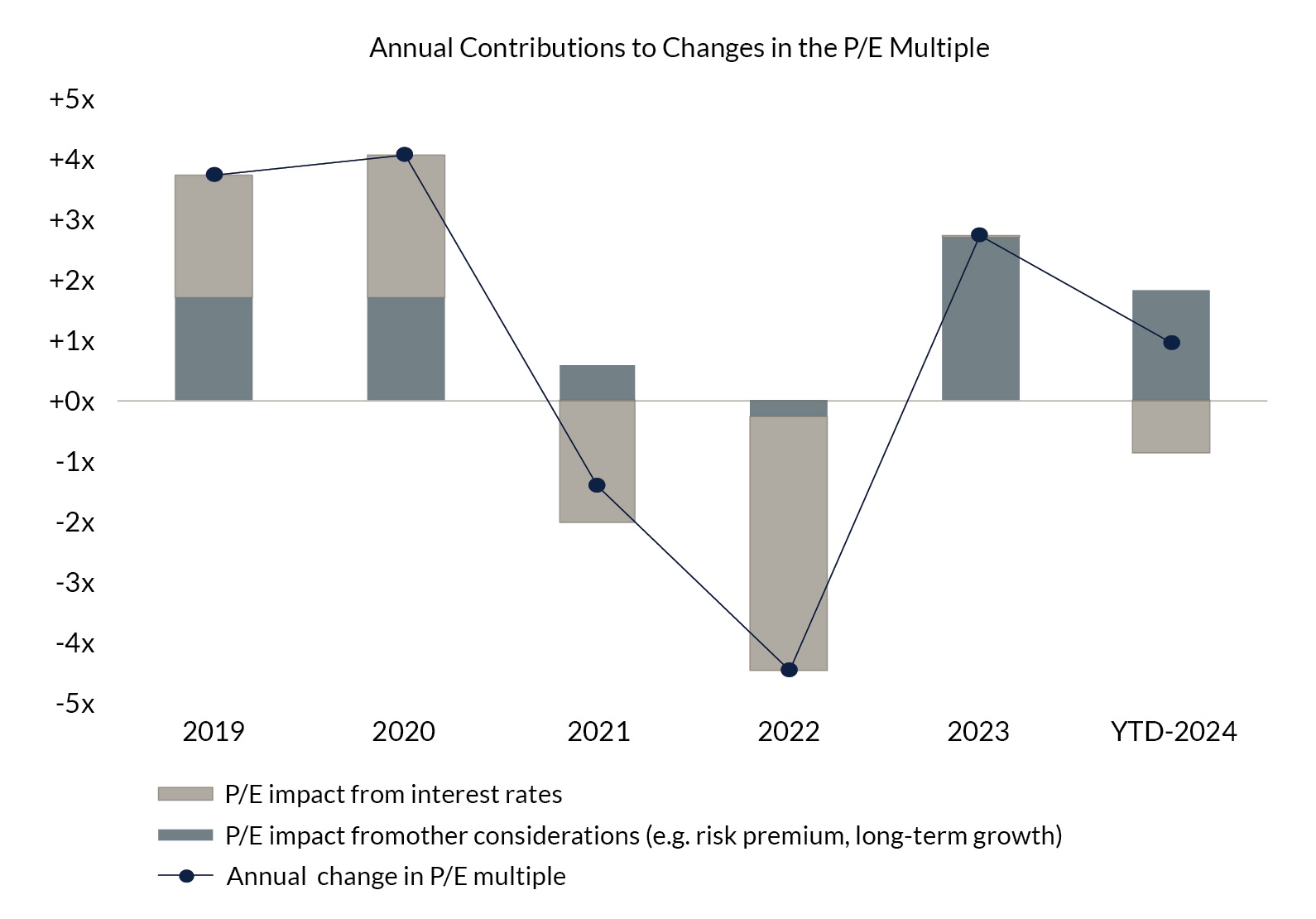
Source: Johnson Asset Management, FactSet, data as of 5/31/2024
Breaking down changes to the P/E multiple in this way can help frame valuation discussions as we consider potential paths for interest rates going forward. For example, futures markets and the Fed’s own dot plot forecast suggest lower interest rates in the near future if inflation remains contained. But does that mean P/E multiples will continue to climb higher? Not necessarily. We believe the risk of a slowing economy remains elevated, and if rates were to fall because of a recession, the P/E expansion we have seen from “other considerations” may be vulnerable as enthusiasm about growth fades and investors demand a higher risk premium. On the other hand, economists continue to debate the direction of interest rates in a soft landing scenario. Are we entering a new era of deflationary pressure through productivity gains through things like artificial intelligence, resulting in lower rates and better “other considerations” that benefit P/E multiples? Or would a long-term secular growth boom associated with things like artificial intelligence or manufacturing reshoring result in inflationary pressures and higher interest rates over time?
These examples help to demonstrate that even an interest rate crystal ball would not create an if/then stock market forecast. While rates have been a primary focus for investors in recent years, we’ve shown that P/E multiples include a wider set of evolving assumptions. For this reason, our team of equity analysts and portfolio managers refrain from making bets on something like the direction of interest rates and, subsequently, P/E multiples. Instead, with quality as the foundation of the Johnson Asset Management investment discipline, we seek to identify high-quality companies with proven leadership, strong competitive positions, healthy balance sheets, and consistent cash flows, applying a variety of tools to analyze market expectations. History shows that businesses with these characteristics, purchased at the right price, will outperform over time.
Published 06/26/2024
Any expectations presented should not be taken as a guarantee or other assurance as to future results. Our opinions are a reflection of our best judgment at the time this presentation was created, and we disclaim any obligation to update or alter forward-looking statements as a result of new information, future events or otherwise. The material contained herein is based upon proprietary information and is provided purely for reference and as such is confidential and intended solely for those to whom it was provided by Johnson Asset Management. If you have any questions about our equity strategies and how we might tailor them to fit your investment objectives, please call 513.389.2770 or via email at info@johnsonasset.com.