
Assessing the Opportunity in SMID vs. Large Cap
SMID Cap Stocks Are Relatively Cheap, But Is That Enough For An Allocation?
Lately, many have observed the valuation gap between SMID cap stocks and their large cap peers. For investors waiting on a catalyst to move into SMID caps, the recent surge in smaller stocks may have prompted some renewed interest. From July 9 to July 31, the Russell 2500 was up over 8.5%, while the S&P 500 fell nearly -1.0%. While much of this outperformance has subsequently reversed, this period helped to illustrate how quickly market dynamics can change. With this in mind, the question for asset allocators remains, how should you consider the merits of tactically shifting smaller in cap size? While the relative valuation opportunity remains compelling, analyzing a potential allocation shift requires exploring two key reasons why this opportunity exists: 1) The heavy concentration of mega cap Tech stocks in the S&P 500, which have distorted sector exposures, and 2) The risk of economic slowdown or recession, which can pose a larger threat to smaller companies.
Large Cap is Less Diversified Than SMID Cap
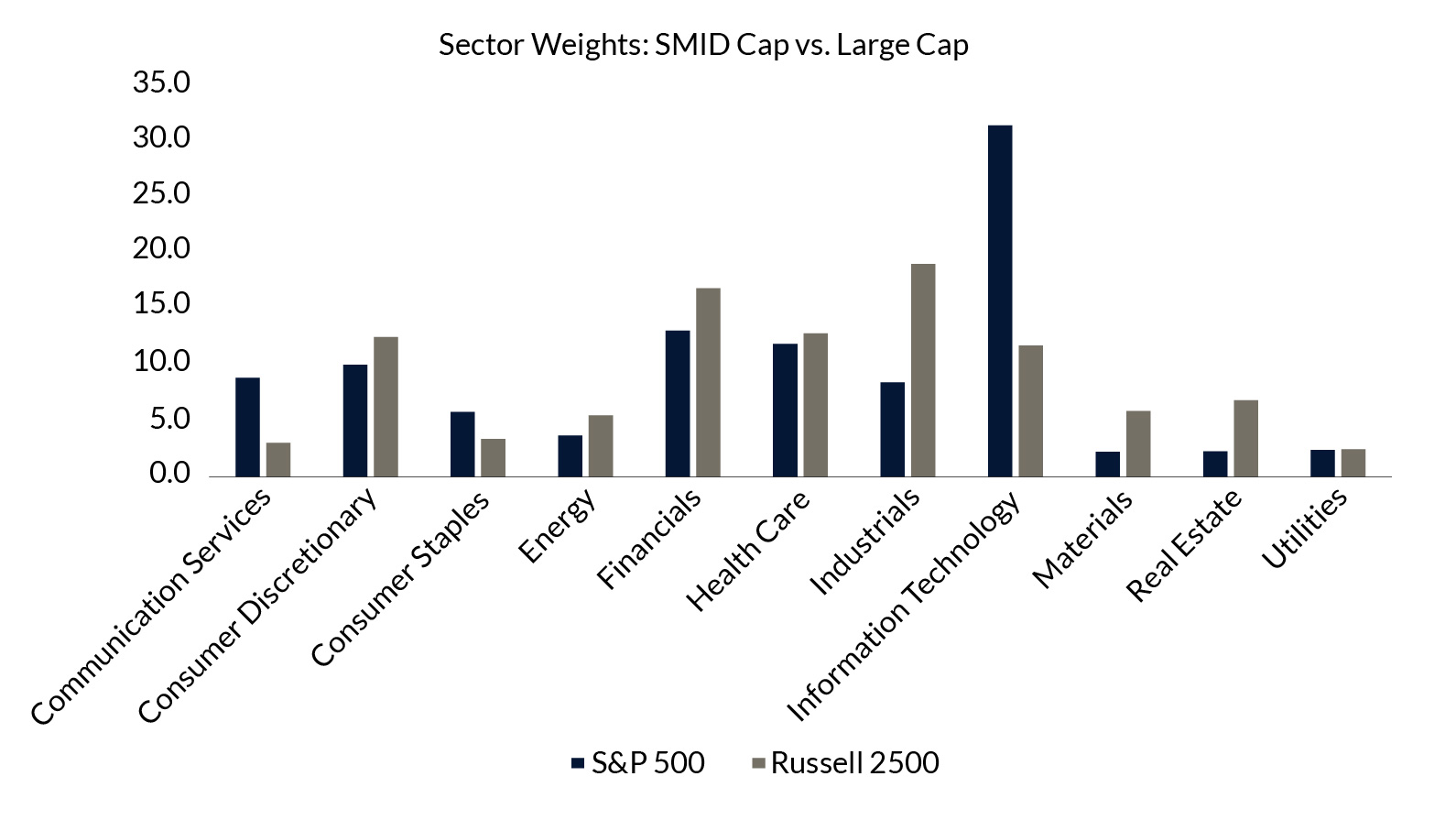
Concentration has been among the most discussed market themes in recent years. Through the first six months of 2024, the five largest stocks in the S&P 500 contributed more than half of the Index’s return, and these same stocks now make up a historically unprecedented 27% of the index. This outsized performance of the Top 5 has pushed sector weights higher in Technology and Communication Services, creating a less diversified sector mix than the Russell 2500 offers. The chart below illustrates the distinctly different sector makeup within the S&P 500 as compared to the Russell 2500.
Source: Johnson Asset Management, FactSet, data as of 7/31/2024
The difference in Information Technology stands out as the most striking divergence, now making up 31% of the S&P 500 vs. only 12% of the Russell 2500 (as of 7/31/24, using GICS sector classifications). In this case, three mega cap Tech stocks, each greater than 6% of the market, can account for the entire gap. The larger weight in the S&P 500 Communication Services sector is also heavily skewed by Google and Meta, which together represent more than half of the sector weight.
Meanwhile, the Russell 2500 offers a more diversified mix, with five times the number of companies and no single stock with a weight larger than 0.4% today. For investors cognizant of the extreme concentration levels within large cap today, SMID cap stocks offer broader exposure across sectors and companies to help reduce concentration risk in your portfolio.
Investing in Quality SMID Cap Reduces the Risk of Small Cap Investing
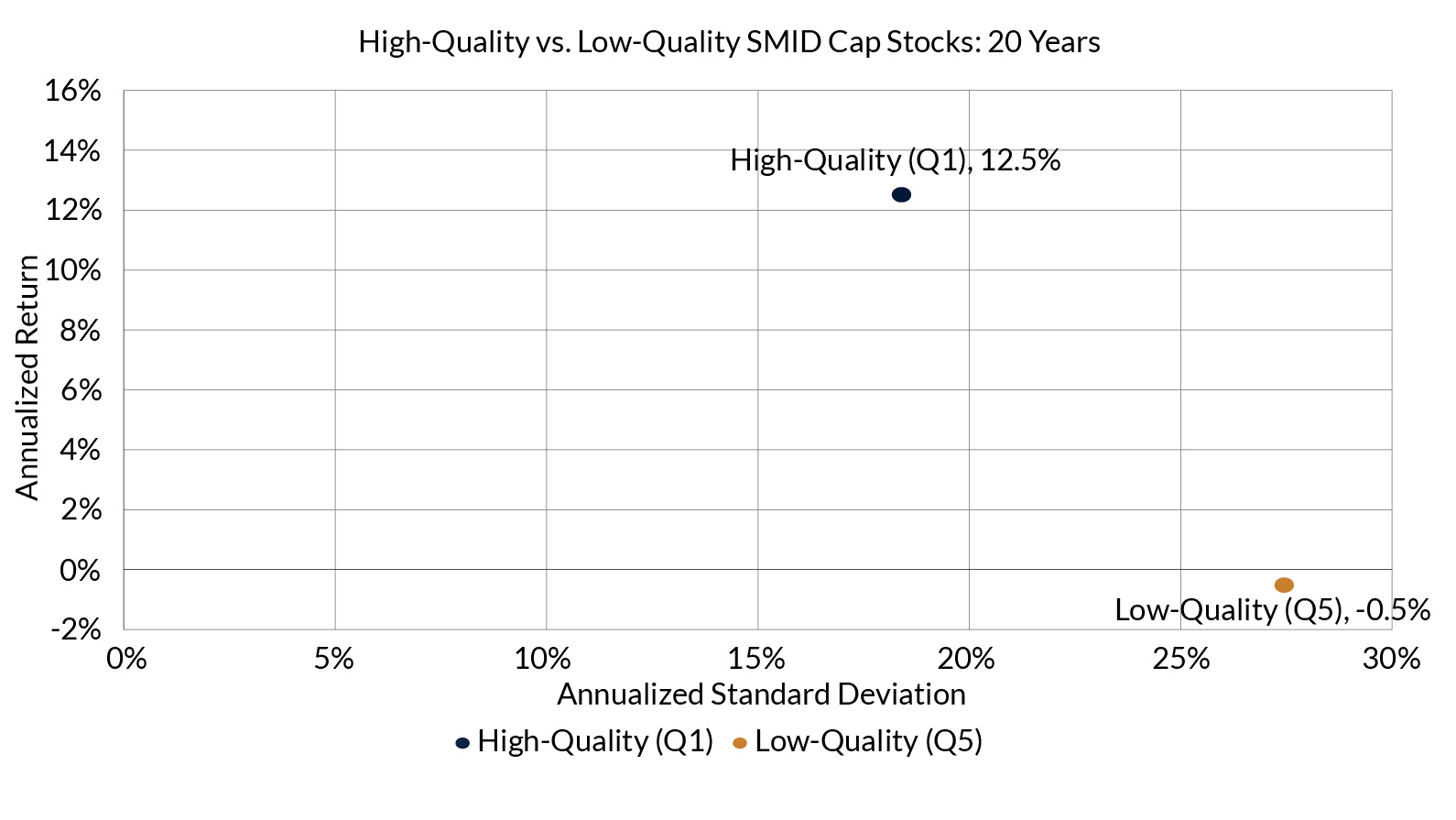
At the same time, while the SMID cap universe offers a more diversified range of stocks, the characteristics of companies in the universe differ from large cap. Notably, the SMID cap universe includes more low-quality companies than large cap. For example, consider biotechnology stocks, where nearly every S&P 500 biotech stock is profitable, and the median industry constituent shows lower price volatility than the typical large-cap stock. Conversely, Russell 2500 biotech is a much riskier bunch, with an overwhelming 94% of the constituents failing to generate a profit in the most recent year and price volatility over the last five years that is 2.8x higher than its large cap cohort.
While not all industries provide as stark a contrast as biotech, the general theme of lower quality characteristics as you move smaller in cap size holds true, as seen in the underperformance of small caps during periods of economic weakness. Through the quality lens, an investor can see where SMID cap stocks might have different performance drivers than large caps, which requires a more discerning judgment based on their views of where the economy and markets are headed. Ultimately, the quality differences between the average SMID cap and large cap stocks help to highlight the importance of a fundamental, bottom-up approach as you consider allocating to smaller companies. History has shown that quality companies with strong management teams, consistent earnings, a strong balance sheet, and a leading competitive position will provide downside protection and reduce volatility in turbulent markets.
Source: Johnson Asset Management, FactSet, return data from 8/1/2005 – 7/31/2024; Russell 2500 stocks sorted into quintiles by quality using a proprietary multi-factor model; “high quality” defined as top quintile (Q1), “low quality” defined as bottom quintile (Q5).
SMID Cap: Tactical Advantage vs. Large Cap | Strategic Advantage vs. Small Cap
Today, an allocation to SMID cap offers an attractive valuation entry point relative to large cap, while helping to diversify portfolios and reduce concentration risk inherent in the S&P 500. In addition to the valuation cushion, concerns around economic slowdown or recession risk can be alleviated by allocating to a quality-focused investment strategy, which will avoid the riskier, unprofitable companies that make up a portion of smaller cap equity indices. At Johnson Asset Management, our high-quality investment discipline is designed to provide downside protection and reduce volatility, offering clients an ideal approach to take advantage of the opportunity in SMID cap stocks today.
Published 09/10/2024
Any expectations presented should not be taken as a guarantee or other assurance as to future results. Our opinions are a reflection of our best judgment at the time this presentation was created, and we disclaim any obligation to update or alter forward-looking statements as a result of new information, future events or otherwise. The material contained herein is based upon proprietary information and is provided purely for reference and as such is confidential and intended solely for those to whom it was provided by Johnson Asset Management. If you have any questions about our equity strategies and how we might tailor them to fit your investment objectives, please call 513.389.2770 or via email at info@johnsonasset.com.