Signs of Stress in Private Credit?
As equity markets have marched steadily higher this year, we’ve kept our eye on the underperformance of numerous publicly traded BDCs, or Business Development Companies, a popular vehicle for accessing private credit markets. As shown in the chart below, the S&P BDC Index has dramatically underperformed the Russell 2000 Index, which broadly represents the types of companies private credit managers seek to lend to.
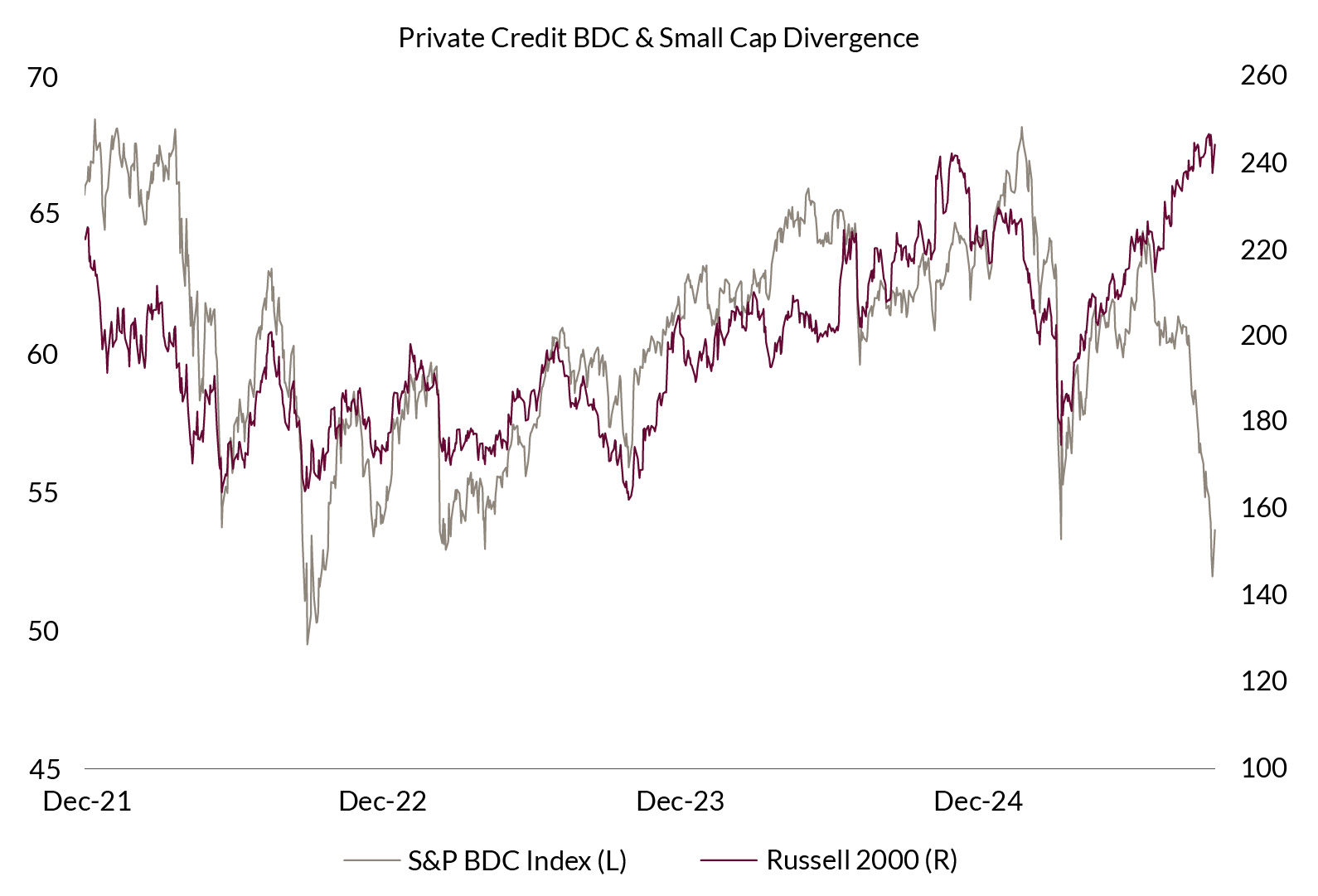
Source: Johnson Asset Management, Bloomberg, data as of 9/30/2025
Given this divergence and the popularity of private credit strategies in recent years, we wanted to provide some background on the BDC market, explore what might be driving this relative underperformance, and outline potential implications for traditional fixed income markets/strategies.
What are Business Development Companies (BDCs)?
Business Development Companies, or BDCs, are investment companies that provide debt and equity financing to small and mid-sized businesses. They function as a vehicle for investors to access the private credit market without committing capital to a traditional private fund. BDCs are also subject to regulations which require that they distribute 90% of taxable income to shareholders. To put it plainly, BDCs bundle private credit loans into a regulated fund with specific investment requirements.
What’s been happening in the space?
BDC stocks have dropped to multi-year lows, and credit spreads on their issued debt have widened. The recent bankruptcies of Tricolor Holdings and First Brands Group reignited fears regarding underwriting standards and inflated valuations across private credit. While both companies had raised financing in public markets, the issues for both originated in complex financing transactions that are common in private credit and highlighted potential issues that might be lurking in the private credit space. Because publicly traded BDCs offer daily liquidity, their share prices have been vulnerable to shifts in investor sentiment as fear of widespread private credit issues have grown.
Where to go from here?
Publicly traded BDCs face two noteworthy headwinds going forward. First, investors of publicly traded BDCs are exposed to shifts in market sentiment. Unlike traditional private funds, publicly traded vehicles can trade at deep discounts to their underlying net asset values (“NAV”). This can be particularly problematic during periods of heavy investor selling. While investors are typically drawn to public BDCs for their more liquid structure, investors seeking liquidity may have to sell at meaningful discounts to NAV, therefore locking in steep losses.
Second, the elevated spreads on BDCs’ debt also increase borrowing costs for managers, pressuring BDC net income. As net income falls, distributions to BDC investors are also at risk of being cut. As the market anticipates dividend cuts, BDC share prices often come under pressure as well.
The Outlook vs. Traditional Core Fixed Income
While private credit has garnered significant attention for its yield potential and perceived insulation from public market volatility, the recent weakness across publicly traded BDCs and signs of strain in parts of the private credit market have raised important questions about where investors are being adequately compensated for risk. As spreads widen and concerns grow over underwriting standards and valuations, the extra yield once associated with private credit appears less compelling—particularly given the trade-offs in transparency and liquidity that come with the asset class.
At the same time, traditional core fixed income has quietly become more attractive. Yields remain near their highest levels in years, credit quality is stable, and bonds once again offer meaningful diversification benefits should growth slow or rates decline. For investors seeking reliable income and liquidity in a more uncertain environment, the balance of risk and reward increasingly favors high-quality, publicly traded fixed income.
Published 12/02/2025
Any expectations presented should not be taken as a guarantee or other assurance as to future results. Our opinions are a reflection of our best judgment at the time this presentation was created, and we disclaim any obligation to update or alter forward-looking statements as a result of new information, future events, or otherwise. The material contained herein is based upon proprietary information and is provided purely for reference and as such is confidential and intended solely for those to whom it was provided by Johnson Investment Counsel. If you have any questions about our fixed income strategies and how we might tailor them to fit your investment objectives, please call 513.389.2770 or via email at info@johnsonasset.com.