
Credit Valuation Warrants a High Quality Approach
Across the credit landscape, valuations are extended. Investment grade credit spreads ended 2024 below 80 bps, near the tightest levels in over 20 years. Despite being a poor tool for timing the market, valuation does provide helpful context for framing the current risk/reward offered by the market. Given the current environment, ensuring your credit-oriented managers employ a high-quality approach will be a key to outperformance as the market cycle progresses.
To analyze the fullness of IG credit valuations, we have looked back over 20 years of data to consider both average excess return and hit rate of excess return, looking 12 months forward for short, intermediate, and long duration credit from various levels of starting spreads. Our data suggests that investors should be cautious about the outlook for credit from current valuation levels.
Short duration credit spreads ended the year at 52 bps. While the hit rate for short duration credit is better than both intermediate and long duration credit, short duration credit spreads are at levels historically consistent with almost zero excess return.
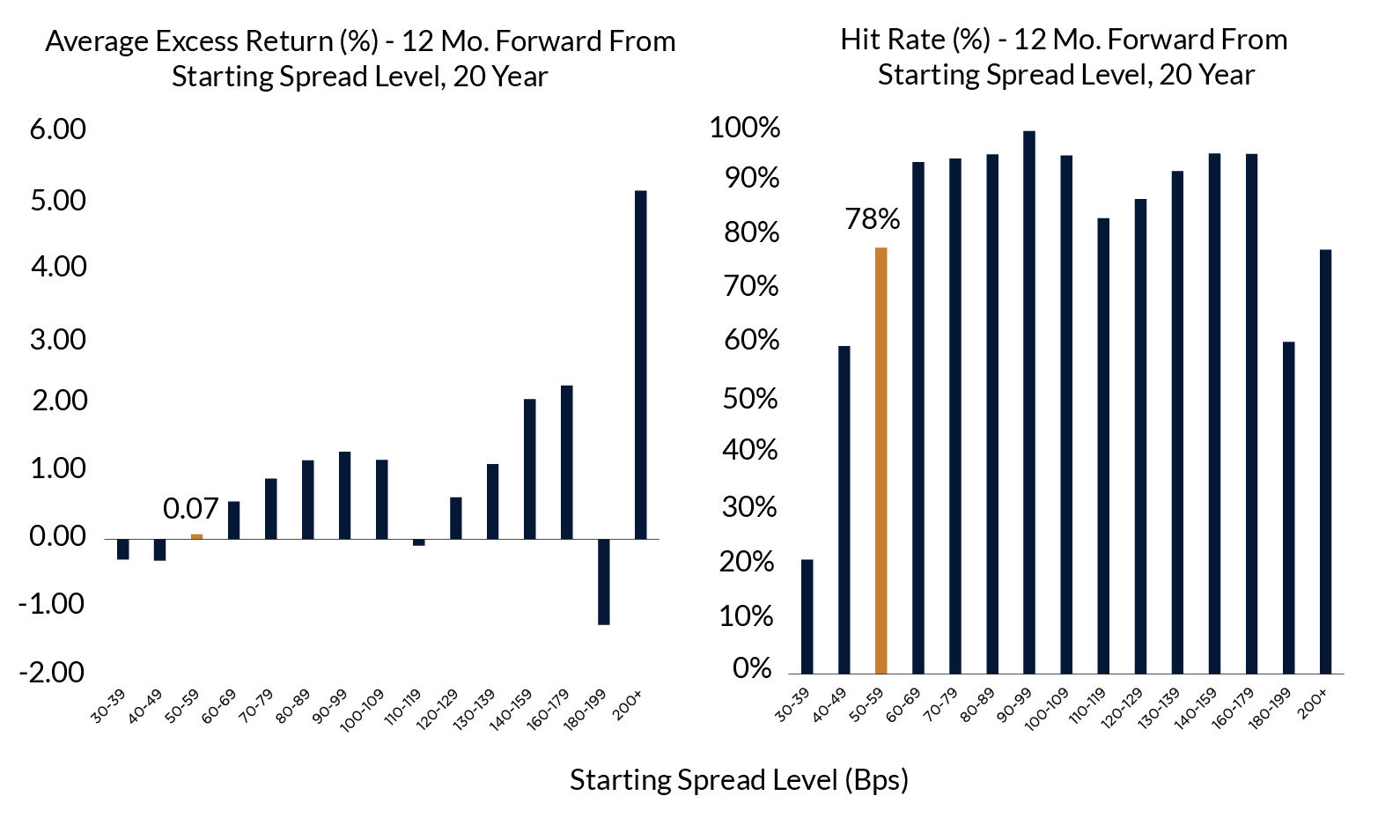
Note: Bloomberg U.S. Corporate 1-3 Year Index
Source: Johnson Asset Management, Bloomberg, Data as of 12/31/2024
The picture for intermediate duration credit looks even bleaker, with just a 15% hit rate from current spread levels and an average excess return of -1.02%.
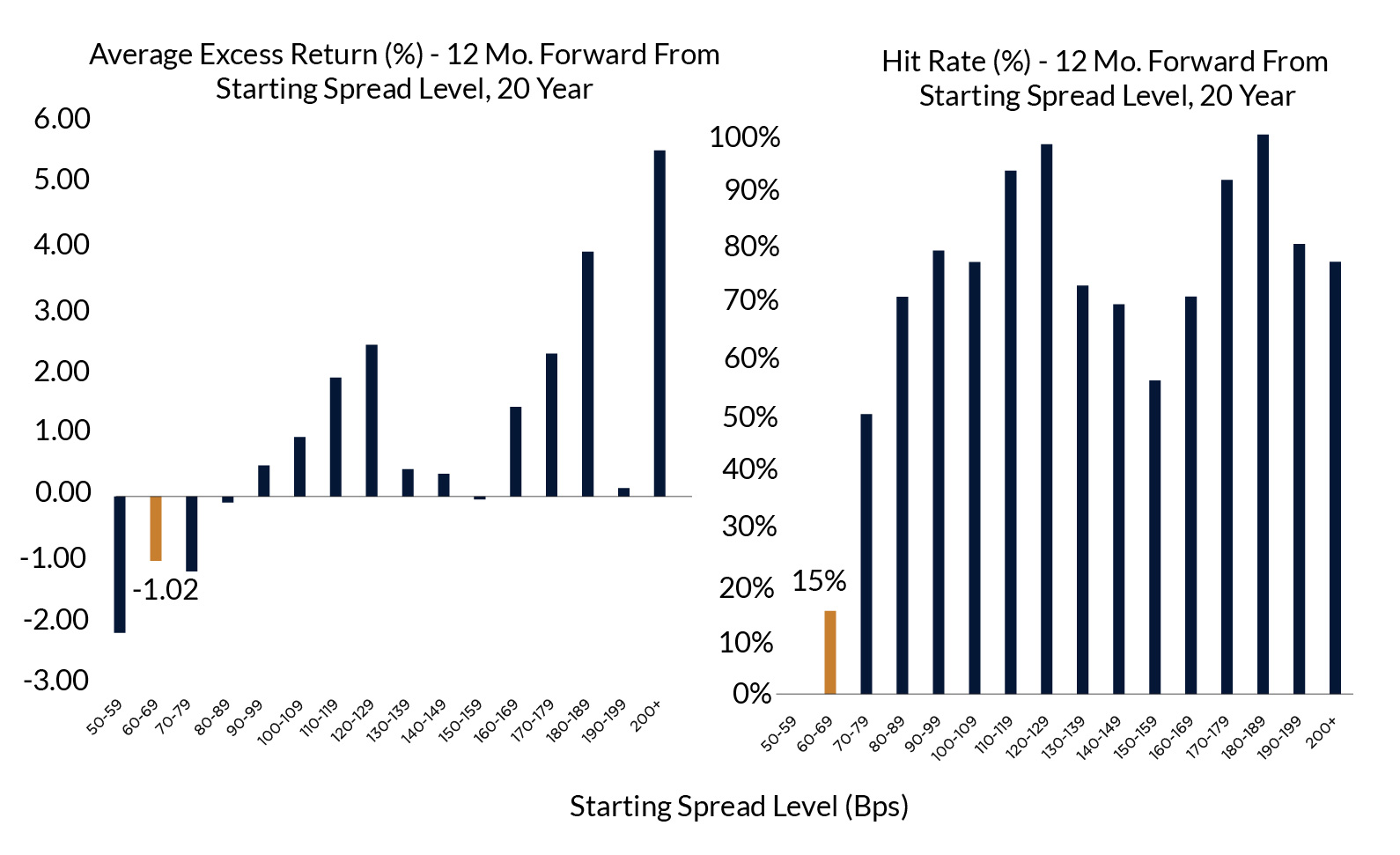
Note: Bloomberg Intermediate Corporate Index
Source: Johnson Asset Management, Bloomberg, Data as of 12/31/2024
Finally, long duration credit spreads, currently sub-100 bps, are literally “off the chart”, at their tightest levels in the data set used for our analysis. Even from levels 10+ bps wider, long duration credit has never outperformed duration-matched treasuries, with an average excess return of -3.76%.
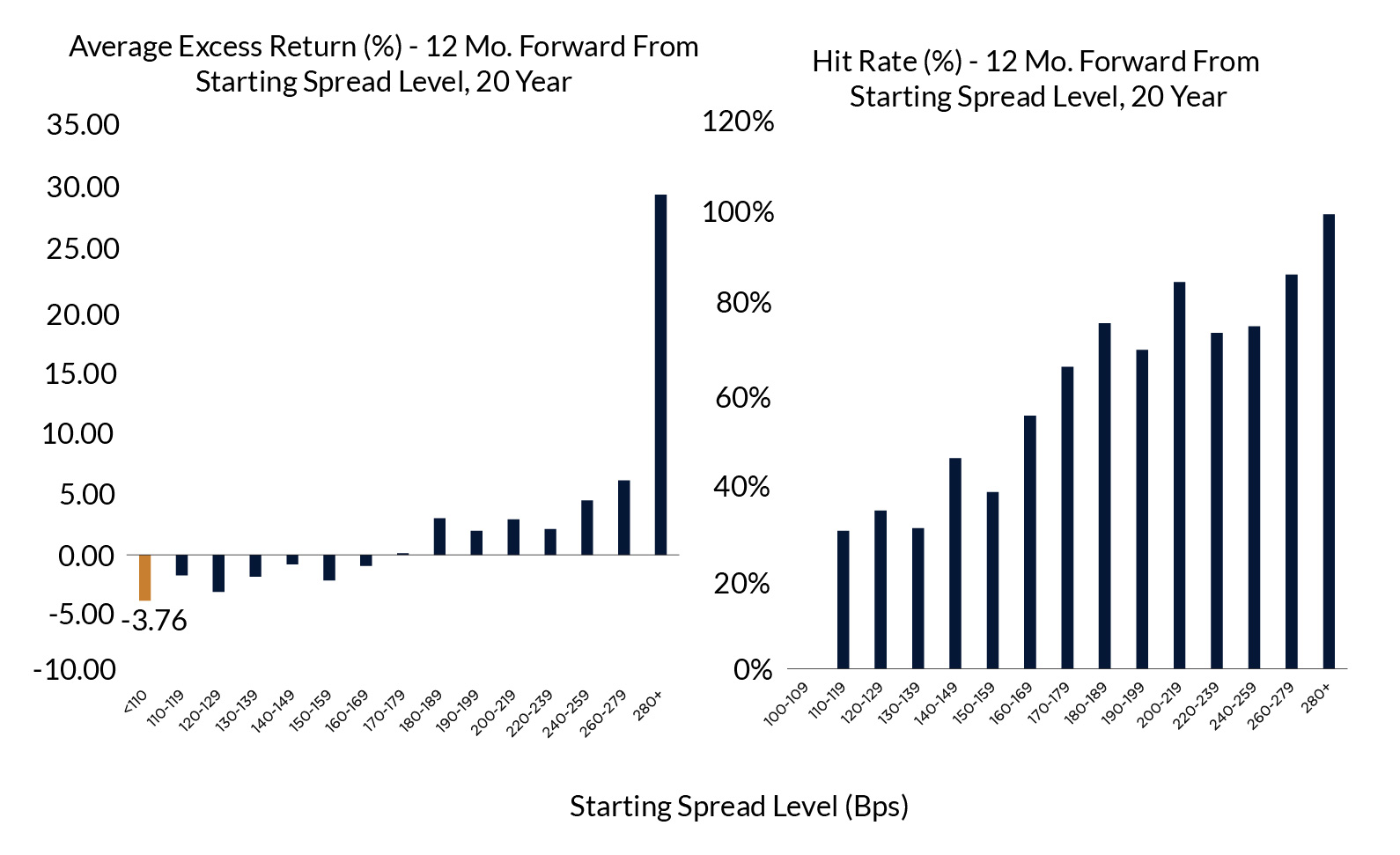
Note: Bloomberg Long U.S. Corporate Index
Source: Johnson Asset Management, Bloomberg, Data as of 12/31/2024
While current valuations in credit warrant caution, this does not mean investors should abandon IG credit in portfolios. There have been periods of time where credit spreads have remained rangebound at historically low levels (most notably 2003-2006). Positioning portfolios in an overly defensive manner may sacrifice yield and dampen long-term portfolio returns.
Instead, we believe employing a high-quality approach provides an ideal avenue for taking advantage of attractive yields while also shielding portfolios from the imbalanced risk/reward tradeoff we see with such full valuations. At Johnson Asset Management, our Quality-Yield investment discipline is designed to do just that. As the table below highlights, we have provided strong excess returns from all levels of starting spreads but have ranked most highly vs. peers in the eVestment Core Fixed Income universe following similar periods of spread tightness
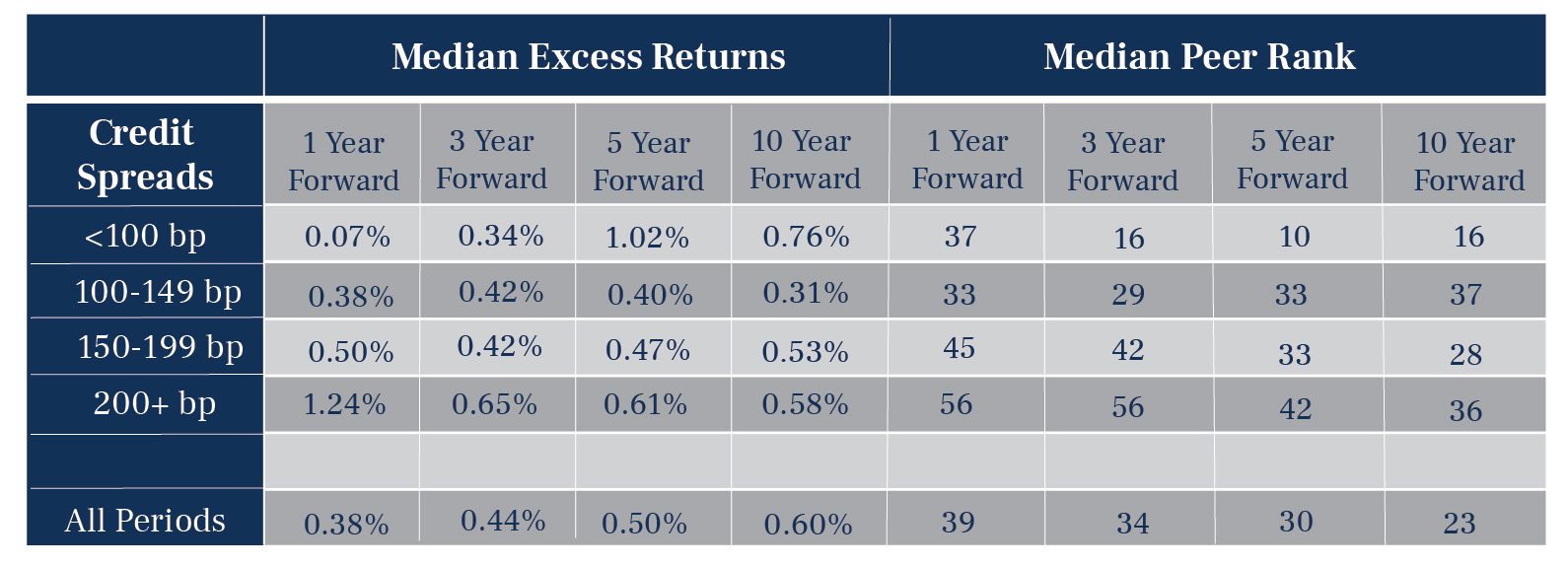
Note: All performance data shown net of fees. Period from January 2002 to December 2024. Credit spreads represented by the Bloomberg US Aggregate Corporate Average OAS Index, which tracks the average option-adjusted spreads for the Bloomberg US Aggregate Bond Index. The Bloomberg US aggregate Bond Index is a broad-based flagship benchmark that measures the investment-grade, us dollar-denominated, fixed-rate taxable bond market. Percentile rank is the median ranking of the Johnson Core Composite net of fees within the Evestment Core Fixed Income separate account net of fee universe, which consists of 102 products as of 12/31/2024 the Evestment Core Fixed Income universe is defined to include us fixed income products that invest in a well-diversified portfolio of investment-grade bonds, with common benchmarks such as the Bloomberg US Aggregate Index. Excess return is the average annualized total return of the Johnson Core Composite compared to the Bloomberg US Aggregate Bond Index. An index is not a security in which an investment can be made. Indices are unmanaged vehicles that serve as market indicators tracking a group of assets in a standardized manner and do not account for the deduction of management fees and/or transaction costs generally associated with investable products.
Looking forward, we believe that our unique approach to high-quality fixed income is well positioned to maximize portfolio yield, while also providing consistent and reliable downside protection. Our high-quality credit selection process actively seeks to avoid low-quality, cyclical credits that are the most prone to valuation dislocations during periods of heightened market volatility.
Published 02/12/2025
Any expectations presented should not be taken as a guarantee or other assurance as to future results. Our opinions are a reflection of our best judgment at the time this presentation was created, and we disclaim any obligation to update or alter forward-looking statements as a result of new information, future events or otherwise. The material contained herein is based upon proprietary information and is provided purely for reference and as such is confidential and intended solely for those to whom it was provided by Johnson Investment Counsel. If you have any questions about our fixed income strategies and how we might tailor them to fit your investment objectives, please call 513.389.2770 or via email at info@johnsonasset.com.